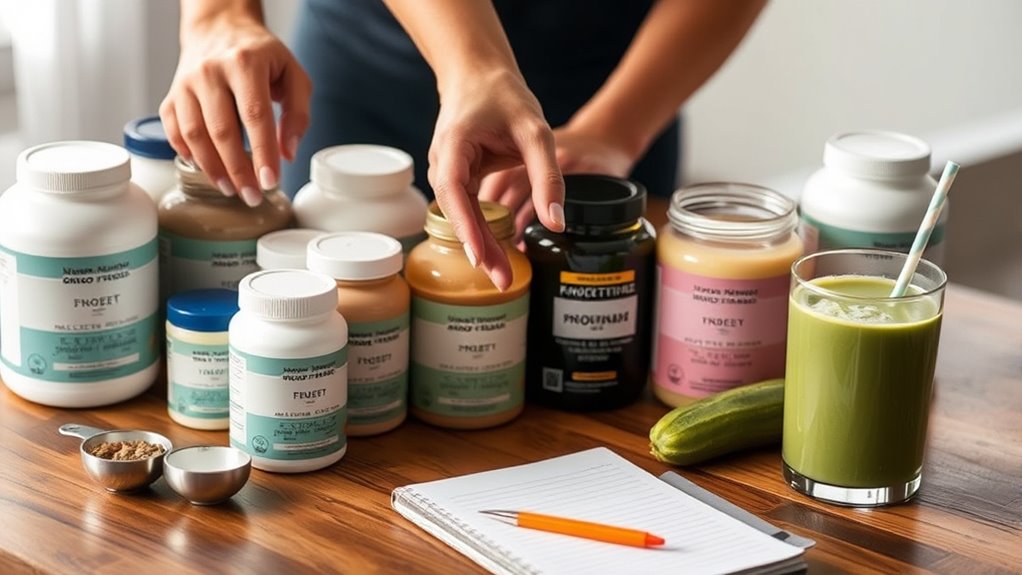
10 Tips to Choose Protein Supplements
To choose protein supplements wisely, start by evaluating your protein needs based on your age, fitness level, and health goals.
Understanding the different protein types available is crucial—whey protein is ideal for muscle gain, while plant-based options suit vegans and those with dietary restrictions.
Checking for complete amino acid profiles ensures you get a supplement that supports recovery and growth effectively.
Look for third-party certifications to guarantee safety and quality.
Factor in your dietary restrictions and the cost per serving to find a supplement that fits your budget.
Don’t forget to test flavors and mixability to find what suits your taste and lifestyle.
Keep these essentials in mind, and you’ll be ready to make the best choice for your health and fitness journey.
Key Takeaways
- Determine your protein needs based on age, activity level, and dietary restrictions before choosing a supplement.
- Select the protein type (whey, casein, plant-based) that aligns with your health goals and dietary preferences.
- Check for third-party certifications and ingredient transparency to ensure supplement safety and quality.
- Analyze cost per serving and container size to optimize value without compromising quality.
- Sample flavors and test mixability with different liquids to find a supplement that suits your taste and texture preferences.
Assess Your Protein Needs
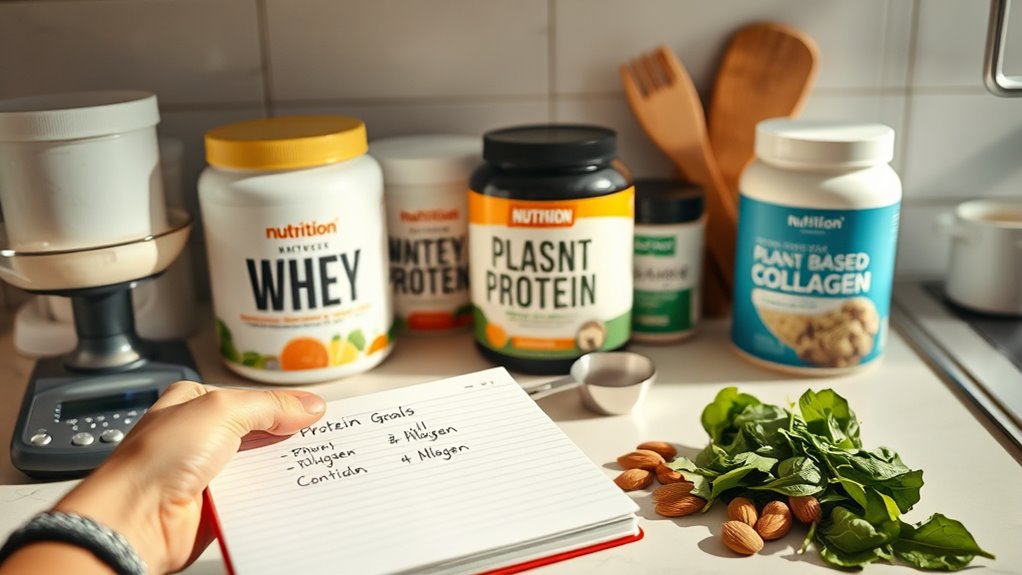
Although the general recommendation is 0.8 grams of protein per kilogram of body weight daily, your individual needs might be higher depending on factors like age, activity level, and health goals. For example, older adults often require 1.0 to 1.2 grams per kilogram to prevent muscle loss, while athletes or those doing strength training may need between 1.2 and 2.0 grams per kilogram to support muscle repair and growth.
To accurately determine your protein needs, consider your body weight and daily requirements carefully. Since these can vary widely, consulting a registered dietitian can help tailor your intake to your specific situation. Evaluating your protein needs correctly ensures you choose the right supplement to meet your nutritional goals effectively.
Decide Between Powder and Ready-To-Drink Options
Once you know how much protein you need, the next step is choosing the form that fits your lifestyle and preferences. You can pick between protein powders and ready-to-drink shakes, each offering unique benefits. Protein powders are economical and versatile, letting you enjoy mixability in smoothies or coffee.
Knowing your protein needs helps you choose between versatile powders and convenient ready-to-drink shakes.
Ready-to-drink shakes provide unmatched convenience, perfect for busy days when you’re on the go.
Consider these factors when deciding between protein options:
- Cost: powders usually cost less per serving than ready-to-drink shakes
- Protein content: shakes vary more widely, powders typically offer 20-25 grams
- Convenience: shakes are pre-mixed and portable, powders need preparation
- Nutrients: shakes often contain added vitamins and minerals, powders usually don’t
Choose what suits your routine and taste best.
Choose the Right Protein Type for Your Goals
Choosing the right protein depends on what you want to achieve—muscle gain, weight loss, or overall health. If you’re aiming for muscle building, animal proteins like whey or casein are your best bet, while plant proteins work well if you follow a vegetarian or vegan lifestyle.
Understanding your goals will help you pick the protein type that fits your needs perfectly.
Match Protein To Goals
When you’re selecting a protein supplement, it’s important to match it to your specific goals rather than just picking the most popular option. Your protein goals should guide your choice, focusing on the amino acid profile and digestion rate that best support your needs.
For muscle building, whey protein isolates are ideal due to their complete amino acid profile and quick absorption. If you prefer plant-based proteins, choose options like pea or rice that offer a full amino acid spectrum or combine sources for balance.
Consider these factors to align your supplement with your goals:
- Muscle building: whey protein for rapid digestion and full amino acids
- Satiety and overnight repair: slower digesting proteins
- Plant-based proteins: ensure complete amino acid profiles
- Digestion rate: important for timing and effectiveness
Animal Vs Plant
Although both animal and plant-based proteins can support your fitness goals, understanding their differences helps you pick the right type for your needs. Animal-based proteins like whey and casein are complete proteins, meaning they contain all nine essential amino acids needed for effective muscle building. Plant proteins, such as soy and pea, are often incomplete but can be combined to provide a full amino acid profile.
Research shows no significant difference in muscle preservation when total daily protein and amino acid profiles are adequate. Animal proteins generally have higher digestibility and biological value, while plant proteins are lower in fat and calories, making them better for weight management. Your choice should align with your dietary preferences, allergies, ethical values, and specific health goals to maximize results.
Muscle Gain Needs
If you’re aiming to build muscle, focusing on high-quality complete proteins like whey or casein is essential because they provide all the amino acids your body needs for repair and growth. To maximize muscle gain, consider these tips when choosing protein powders:
- Opt for hydrolyzed whey isolates post-workout for fast digestion and absorption.
- Consume 20-30 grams of protein within 60 minutes after training to boost muscle protein synthesis.
- Combine plant-based proteins like pea and rice to get a complete amino acid profile if you prefer vegan options.
- Distribute your protein intake evenly across meals, aiming for at least 20 grams per serving to support continuous muscle repair.
Choosing the right protein type tailored to your muscle gain needs guarantees efficient recovery and ideal growth.
Verify Protein Quality and Amino Acid Profile
You’ll want to make certain your protein supplement contains all nine essential amino acids to be considered a complete source. Check the amino acid profile on the label and look for third-party testing to confirm accuracy and purity.
This helps guarantee you’re getting quality protein without unwanted additives.
Essential Amino Acids
A quality protein supplement should provide all nine essential amino acids your body needs to repair muscles and maintain health. These essential amino acids enable efficient protein synthesis, vital for muscle growth and recovery. When choosing supplements, focus on the amino acid profile to guarantee it meets your nutritional needs.
Keep these points in mind:
- Complete proteins like whey, casein, soy, and egg naturally contain all essential amino acids.
- Incomplete plant-based proteins may require blending sources (e.g., rice and pea) to cover the full spectrum.
- Review supplement labels carefully to verify the amino acid profile.
- The presence of all essential amino acids determines the protein’s biological value and effectiveness.
Checking these details helps you pick a supplement that truly supports your fitness goals.
Complete Protein Sources
Choosing from complete protein sources makes it easier to get all nine essential amino acids your body needs for muscle repair and overall health. Animal-based proteins like whey, casein, eggs, and dairy naturally provide a complete protein profile with high protein quality.
If you prefer plant-based proteins, look for options like soy, quinoa, or buckwheat, as they also offer complete amino acid profiles. Some plant proteins, such as rice or pea, lack certain essential amino acids, so combining them is necessary to create a complete protein.
When selecting supplements, check the label for indicators of protein quality, like Biological Value (BV) and Protein Digestibility Corrected Amino Acid Score (PDCAAS). These scores help guarantee you’re getting a supplement with all essential amino acids in the right balance for ideal results.
Third-Party Testing
While selecting protein supplements with complete amino acid profiles is important, it’s equally important to verify their quality and safety through third-party testing. This independent verification guarantees the product meets strict quality standards, confirming both purity and potency. Third-party certification also guarantees the supplement is free from harmful contaminants and banned substances.
When choosing your protein powder, look for:
- Seals from reputable organizations like NSF, Informed Sport, or USP
- Laboratory testing for heavy metals such as lead, arsenic, cadmium, and mercury
- Transparent labeling that matches verified ingredient lists
- Certification ensuring adherence to rigorous manufacturing practices
Look for Third-Party Certification
When you pick a protein supplement, it’s crucial to check for third-party certification to guarantee the product’s safety and quality. Certification from reputable organizations like Informed Sport, NSF, or USP means the supplement has undergone independent third-party testing for banned substances, contaminants, and ingredient accuracy. This ensures supplement safety by verifying the absence of harmful substances such as heavy metals and pesticides.
Look for certification labels on the packaging—they signify the product meets stringent quality standards. Choosing certified protein powders gives you confidence that what’s on the label truly reflects what’s inside, reducing risks of contamination or adulteration. Prioritizing third-party certification helps you select a trustworthy protein supplement that supports your health and fitness goals effectively.
Avoid Added Sugars and Fillers
When choosing protein supplements, you’ll want to check labels carefully for hidden sugars like sucrose or maltodextrin that add calories without benefits. Watch out for common fillers and artificial sweeteners that might upset your stomach or spike blood sugar.
Opt for unsweetened powders or those naturally flavored to keep your supplement clean and effective.
Identify Hidden Sugars
Because added sugars and fillers can quietly increase calories and reduce protein quality, you’ll want to scrutinize nutrition labels closely. Hidden sugars often sneak in through ingredients you might not expect. To identify them, focus on these key points:
- Check nutrition labels for added sugars like sucrose, glucose, or high-fructose corn syrup.
- Avoid artificial sweeteners and fillers that don’t add protein value.
- Read the ingredient list thoroughly, especially the latter part, for thickening agents or flavorings that may contain hidden sugars.
- Choose unsweetened or low-sugar protein powders to minimize sugar intake.
Recognize Common Fillers
Besides hidden sugars, common fillers in protein supplements can quietly undermine your health goals. Many powders include additives like artificial flavors, coloring agents, and thickeners to improve taste and texture but these fillers might cause digestive issues or allergies. Added sugars such as maltodextrin or dextrose not only increase calories but also spike blood sugar levels, sabotaging weight management.
To avoid these pitfalls, always scrutinize the ingredient list for unnecessary additives and fillers. Choose products with minimal ingredients and low added sugars—ideally no more than 1-2 grams per serving. High-quality protein supplements typically provide at least 20 grams of protein with few extras.
Choose Unsweetened Options
Although it might be tempting to choose flavored protein powders, opting for unsweetened options can help you avoid added sugars and unnecessary fillers that undermine your health goals. Unsweetened protein powders typically contain no added sugars and feature minimal ingredients, making them a cleaner choice.
By steering clear of artificial sweeteners, you also reduce the risk of gastrointestinal discomfort. Plus, unsweetened powders give you the freedom for flavor customization using natural ingredients like fruit or vanilla extract.
When selecting your protein supplement, remember:
- Check labels for no added sugars or hidden fillers
- Avoid products with maltodextrin, dextrose, or artificial sweeteners
- Choose powders listing only protein and minimal ingredients
- Use your own flavor customization to suit your taste
This approach ensures a healthier, more personalized protein supplement.
Consider Dietary Restrictions and Allergies
When choosing a protein supplement, you’ll want to carefully consider any dietary restrictions or allergies you have to avoid unwanted reactions. Always check allergen labels for dairy allergies, soy, gluten, or nuts. If you’re vegan or vegetarian, plant-based protein powders like pea or rice protein are ideal.
For lactose intolerance, opt for lactose-free options such as whey isolate or plant proteins. Also, watch out for artificial sweeteners or preservatives that might trigger sensitivities. Consulting a healthcare professional can guarantee your choice fits your dietary restrictions and health needs.
| Dietary Restriction | Recommended Protein Type | Notes |
|---|---|---|
| Dairy allergies | Plant-based protein | Avoid whey concentrate |
| Lactose intolerance | Whey isolate, plant-based | Lactose-free options |
| Vegan/Vegetarian | Pea, rice protein | No animal products |
| Allergies (nuts) | Check allergen labels | Avoid nut-derived proteins |
Compare Cost Per Serving of Protein Powders
Choosing the right protein supplement means paying close attention to the cost per serving, which can vary widely. When you compare protein powders, consider the price comparison alongside serving size and protein source. Here’s what to keep in mind:
- Protein powders usually cost $1 to $2 per serving, while ready-to-drink shakes run $2 to $4. Larger containers often lower the cost per serving compared to small packages or single servings. Whey-based proteins typically cost less per serving than plant-based options, due to sourcing differences.
- The form of protein—concentrate, isolate, or hydrolyzed—also affects price.
Always check the label for servings per container to accurately assess the cost per serving and find the best value for your needs.
Test Flavors and Mixability
After you’ve compared costs and protein sources, it’s wise to test flavors and mixability before committing to a product. Flavor testing helps you find a taste you enjoy and can stick with regularly. Try mixing powders with different liquids like water, milk, or plant-based alternatives to see which combination suits your preferences best.
Pay close attention to mixability—shake or stir thoroughly to check if the powder dissolves smoothly or clumps, affecting texture. Some flavors include artificial sweeteners or fillers that might impact taste and your overall satisfaction. Sampling small amounts before buying larger containers ensures the flavor and mixability meet your expectations.
This way, you won’t be stuck with a product you don’t like or can’t blend well.
Use Protein Supplements to Complement Whole Foods
Although protein supplements can be convenient, you shouldn’t rely on them to replace whole foods, which provide a wider array of essential nutrients. Protein powders are best used to complement whole foods in your mixed diets, ensuring you get a full spectrum of nutrients. Whole foods like meats, beans, and nuts supply fiber, vitamins, and minerals that supplements can’t offer.
Protein supplements are convenient but should complement—not replace—nutrient-rich whole foods like meats, beans, and nuts.
To effectively use protein supplements, consider these tips:
- Add protein powders to oatmeal or yogurt to boost protein intake
- Use supplements to fill specific dietary gaps
- Maintain a balance between supplements and nutrient-dense whole foods
- Avoid relying solely on protein powders to prevent nutritional deficiencies
Frequently Asked Questions
What Should I Consider When Buying Protein Supplements?
When buying protein supplements, you should consider the protein source to fit your dietary needs, like whey or plant-based options. Check ingredient lists for added sugars or fillers you want to avoid. Choose brands that are third-party tested for safety.
Think about your fitness goals—muscle gain or weight loss—and pick a protein that supports them. Also, consider flavor and mixability so you’ll actually enjoy using it regularly.
How Do I Know What Protein Powder Is Best for Me?
To know what protein powder’s best for you, you need to take into account your goals, your body’s needs, and your lifestyle. If you want muscle gain, pick whey; if you need a slow-release protein, try casein.
If you’re vegan or lactose intolerant, plant-based options work better. Check the amino acids, avoid harmful additives, and choose flavors you’ll enjoy.
Ultimately, it’s about matching your preferences with your health goals.
What Is the 10 Rule for Protein?
The 10 Rule for Protein means you should aim to get at least 10 grams of protein per serving to help your muscles repair and grow effectively. You’ll want to choose protein sources that offer a complete amino acid profile with this minimum amount.
Spreading multiple 10-gram servings throughout your day makes it easier to meet your daily protein needs and supports your health and fitness goals consistently.
What to Avoid When Buying Protein Powder?
Avoid protein powders that are wolves in sheep’s clothing—those with artificial sweeteners like aspartame or sucralose, which might upset your stomach. Steer clear of products loaded with unnecessary fillers, sugars, or vague ingredients.
Always check for third-party testing to dodge heavy metal contamination. Don’t buy powders with unclear labels or unverified ingredient lists; they could sabotage your nutrition goals instead of supporting them.
Conclusion
Choosing the right protein supplement isn’t just about muscle—it’s about fueling your body wisely. You’ve got the tools: know your needs, check quality, and don’t forget taste.
Remember, protein supplements are a helper, not a hero; whole foods still lead the way. So, don’t just pick any powder—choose the one that fits your life like a glove.
After all, your body deserves nothing less than the best protein supplements for optimal health and performance.